Why this needed to exist
My notes were scattered across six apps before I built Strand. Turns out that wasn't just me.

My own setup before Strand was embarrassing. My notes were scattered across six apps — research in Obsidian, quick notes in Apple Notes, screenshots dumped in Photos, half-finished docs in Notion, and whatever ChatGPT or Claude had told me buried somewhere in a chat history I could never search. I'd forget which app a thing was in before I forgot the thing itself.
The honest part: I didn't really go back to old notes at all. I'd just download the same PDF again, or save the same link a second time, because finding the first copy took longer than getting a new one. My "research" was mostly re-collecting things I already had.
So before I wrote a line of Strand, I read. Not surveys, thousands of reviews and threads, from people who'd never spoken to each other saying the same handful of things.
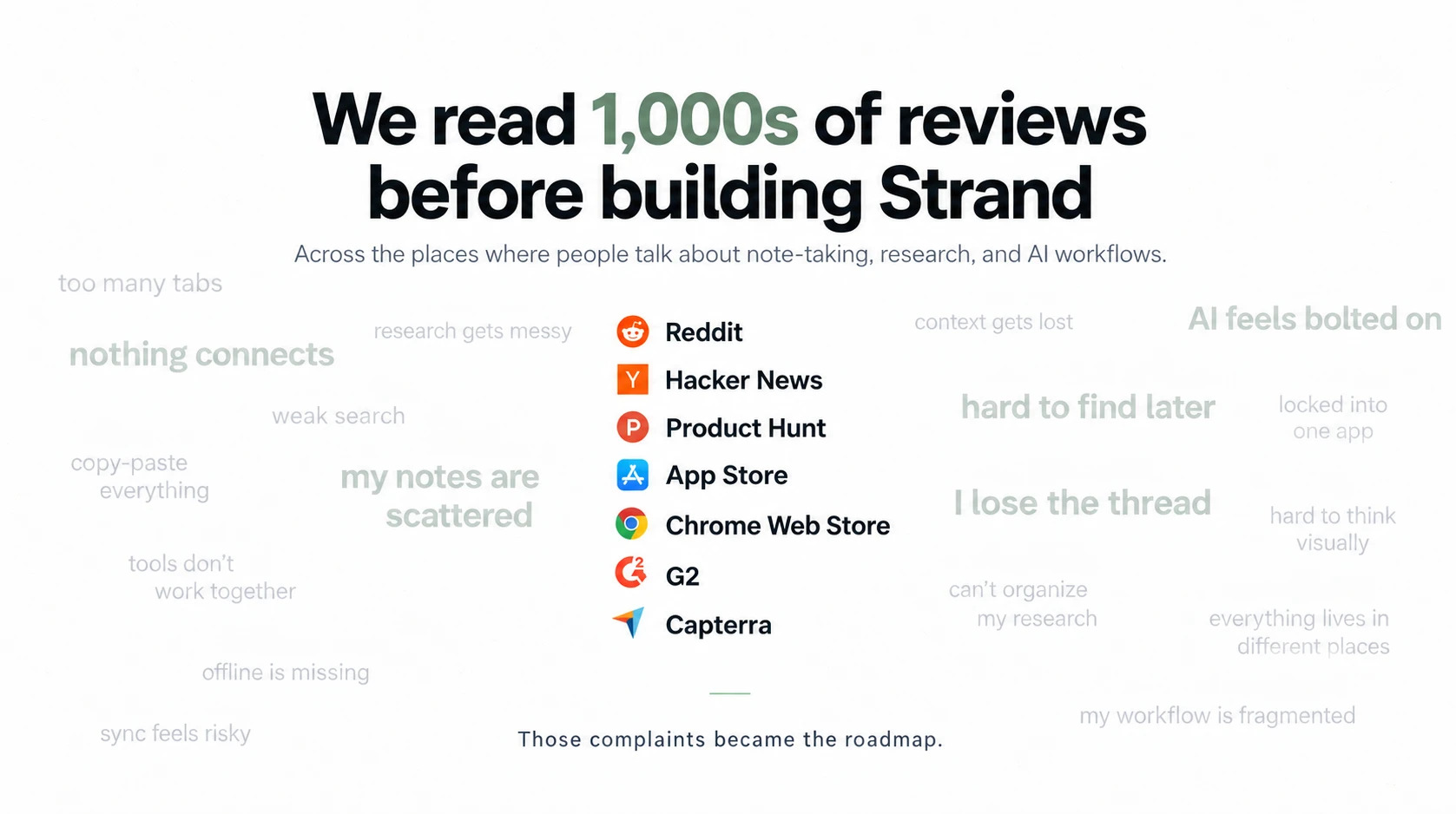
A founder watching Notion eat ideas before he could type them. A still-open request for Canvas arrows to count as real links. "Which folder, which file" the moment a link gets pasted in. A search that can't find the one card someone knows they saved. I needed something that didn't do this to me, so I made it.
One pattern I'd have missed on my own: a three-star G2 review and a two-year-old Reddit thread, written years apart by strangers, both used the exact phrase "migration tax." I only caught it because I'd dropped both onto a Strand board, and it drew the string for me — labeled both mention migration tax. That's the moment this stopped being market research and started being the pitch.
The markdown-pile one is personal. I'd ask an agent to look into something and get back a README, a SUMMARY, a NOTES file, and a half-written TODO — none of which I asked for, all of which I was now supposed to read. I hated it. I didn't want more files. I wanted an answer, with the sources attached, in one place.
And honestly, I wanted it to look like something. Most research tools look like a spreadsheet that learned to render HTML — gray panes, a sidebar inside a sidebar, density standing in for usefulness. I spend hours a day in whatever tool I pick. It should be calm to sit in, not just technically capable.
This isn't the same thing as a "Space"
Two days before I wrote this, OpenAI shipped ChatGPT Space — a shared workspace built around documents, for teams. Perplexity has had its own Spaces for a while too. Both are a real answer to a real problem: conversations and files that used to live in fifty tabs now live behind one name, with teammates attached.
But a better folder is still a folder. A Space doesn't notice that a PDF sitting outside it says the same thing as a page inside it. It won't tell you that two things you read three weeks apart used the same phrase. It's built for a team organizing a deliverable, not for one person noticing a pattern across everything they've collected. That's the part nobody's folder does — ours included, until we built strings for it.
That's really the whole distinction. Strand was never trying to be a better notes app, and a Space is still a workspace bolted onto a chat window. What we're building underneath both is a knowledge ecosystem — capture, connections, citations and an AI plugin, all sitting on top of files you keep, not a page you rent.
So, why did this need to exist? Because I looked for the tool that did this already, read thousands of people just as frustrated as I was, and didn't find one. I needed something like this. So I made it.